Online Pet Vet Pharmacy: Best Deals Up to 40% Off + FREE Shipping on Orders €100+




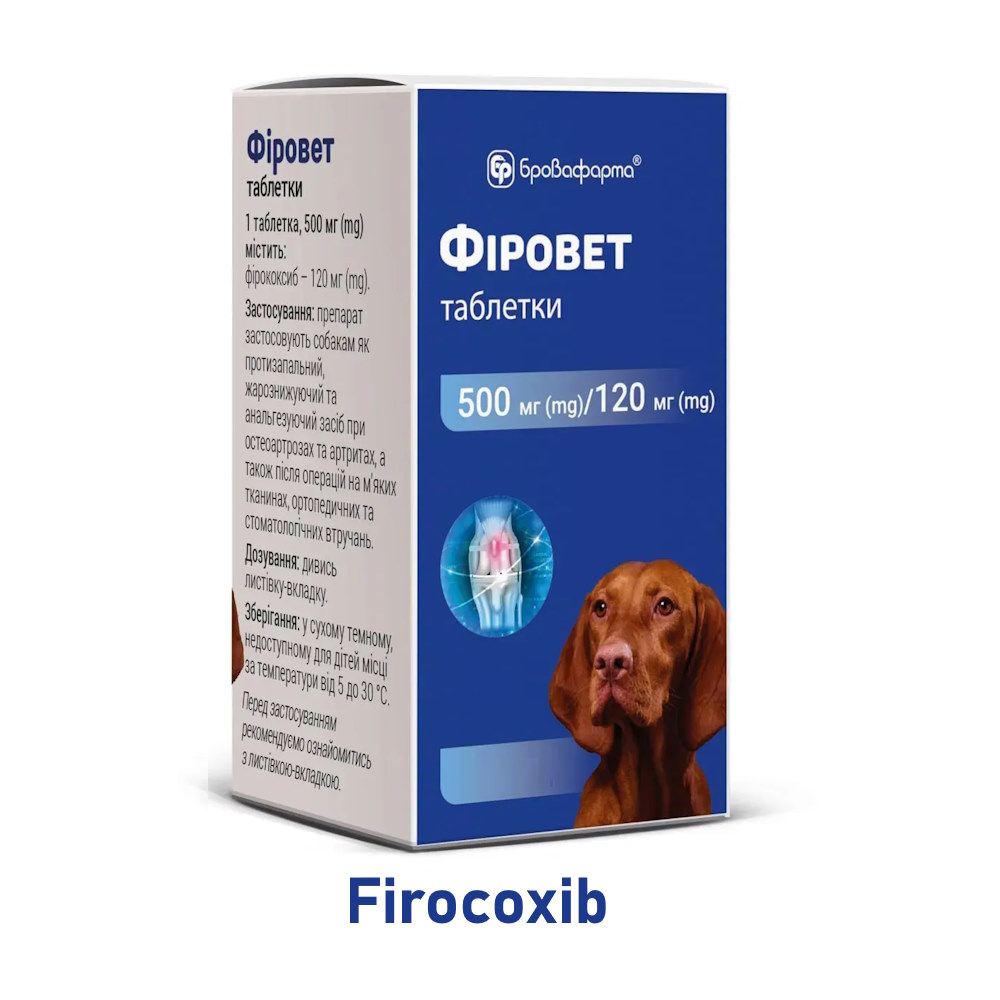


Fironext 500 mg for dogs 100 tablets
Description
Tablets are white or light gray, oval in shape with a notch.
Composition
100 mg of the drug contains:
firocoxib — 24 mg
Pharmacological properties
A nonsteroidal anti-inflammatory drug (NSAID) from the coxib group. It acts by selectively inhibiting cyclooxygenase-2 (COX-2), a mediated prostaglandin synthesis. COX-2 is an isoform of the enzyme that is activated by pro-inflammatory stimuli and is responsible for the synthesis of mediators of pain, inflammation and fever. Coxibs provide analgesic, anti-inflammatory and antipyretic effects. COX-2 is involved in ovulation, implantation, closure of the ductus arteriosus, as well as in the functioning of the CNS, in particular in the mechanisms of fever development, pain perception and cognitive functions. In in-vitro analyses of canine whole blood, firocoxib showed 380-fold greater selectivity for COX-2 compared to COX-1. The required concentration of firocoxib for 50% inhibition of the COX-2 enzyme (IC50) is 0.16±0.05 μmol, and the required IC50 concentration for inhibition of COX-1 is 56±7 μmol.
After oral administration to dogs at a dose of 5 mg per 1 kg of body weight, firocoxib is rapidly absorbed and after 1.25±0.85 hours reaches Cmax – 0.52±0.22 μg/ml (equivalent to 1.5 μmol), area under the concentration-time curve (AUC0-24) – 4.63±1.91 μg*h/ml, bioavailability – 36.9±20.4%. The half-life (t1/2) is 7.59±1.53 hours. Firocoxib is almost 96% bound to blood plasma proteins. With repeated oral administration, the equilibrium concentration is reached by the third daily dose.
Metabolized in the liver by dealkylation and glucuronidation. Excreted mainly with bile and through the gastrointestinal tract.
Indication
It is used in dogs as an anti-inflammatory, antipyretic and analgesic for osteoarthritis, arthritis, after soft tissue surgeries, orthopedic and dental procedures.
Contraindication
Do not use in animals with hypersensitivity to the active ingredient of the drug, pregnant and lactating animals, dogs under 10 weeks of age or weighing less than 3 kg, animals with gastrointestinal bleeding, blood diseases, hemorrhagic syndrome, severe renal and hepatic insufficiency.
Do not use simultaneously with corticosteroids and other NSAIDs.
Method of administration and doses
The drug is used orally during or without food once a day. The dose is 5 mg per 1 kg of body weight.
The number of tablets depending on the dog’s weight and firocoxib content is indicated in the table.
| Dog weight, kg | Number of tablets | |
|---|---|---|
| 200 mg (48 mg firocoxib) |
500 mg (120 mg firocoxib) |
|
| 3–4,8 | 0,5 | |
| 4,9–9,6 | 1 | |
| 9,7–14,4 | 1,5 | |
| 14,5–19,2 | 2 | |
| 19,3–24 | 2,5 | 1 |
| 24,1–28,8 | 3 | |
| 28,9–36 | 1,5 | |
| 36,1–48 | 2 | |
| 48,1–60 | 2,5 | |
| 60,1–72 | 3 | |
| 72,1–84 | 3,5 | |
| 84,1–96 | 4 | |
The duration of treatment for osteoarthritis is determined by a veterinarian. Use of the drug for more than 90 days should be under the supervision of a physician.
To reduce pain and inflammation after surgery (on soft tissues, bones, or teeth), the drug is given 2 hours before the start of the surgery, and then, if necessary, once a day for 2–3 days.
Reservation
Do not exceed the specified doses!
When used in recommended doses, side effects usually do not occur. Sometimes vomiting and diarrhea occur, which resolve after discontinuation of treatment. Very rarely, dogs may experience impaired kidney, liver, or nervous system function. In the event of vomiting, diarrhea, occult blood in the feces, sudden weight loss, anorexia, lethargy, deterioration of biochemical parameters of the kidneys or liver, use of the drug should be discontinued and consult a veterinarian.
It is risky to use the drug in young animals and animals with suspected kidney, heart or liver dysfunction. Animals with such diagnoses require careful veterinary supervision.
Do not use the drug in case of dehydration, hypovolemia, hypotension, as there is a risk of increased toxic effects on the kidneys. Do not use simultaneously with nephrotoxic drugs due to possible kidney damage. If there is a possibility of gastrointestinal bleeding or intolerance to NSAIDs, control by a veterinarian is mandatory.
Other anti-inflammatory agents should be discontinued at least 24 hours before treatment begins to prevent side effects.
During operations using NSAIDs and anesthetics, it is advisable to administer parenteral fluids to maintain renal perfusion.
Concomitant use of substances with high protein binding may displace firocoxib and increase the risk of toxic reactions.
Minor overdose in dogs older than 14 months of age did not cause adverse effects. When firocoxib was administered to dogs aged 10 weeks at a daily dose of 25 mg per kg body weight or higher (5 times the recommended dose) for three months, weight loss, poor appetite, lipid accumulation in the liver, cerebral vacuolation, duodenal ulcers and death were observed. When a daily dose of 15 mg per kg body weight (3 times the recommended dose) was administered for six months, adverse symptoms (except duodenal ulcers) were also observed, but their severity and frequency were less. In some dogs, these signs of toxicity were reversible after discontinuation of therapy. Treatment of dogs aged 7 months at a dose of 25 mg per kg body weight (5 times the recommended dose) for six months caused adverse effects, such as vomiting.
If clinical signs of overdose appear, stop treatment immediately!
Storage conditions
In a dry, dark place, out of reach of children, at a temperature of +5 to +30 °C.
Expiration date
2 years.