Online Pet Vet Pharmacy: Best Deals Up to 40% Off + FREE Shipping on Orders €100+




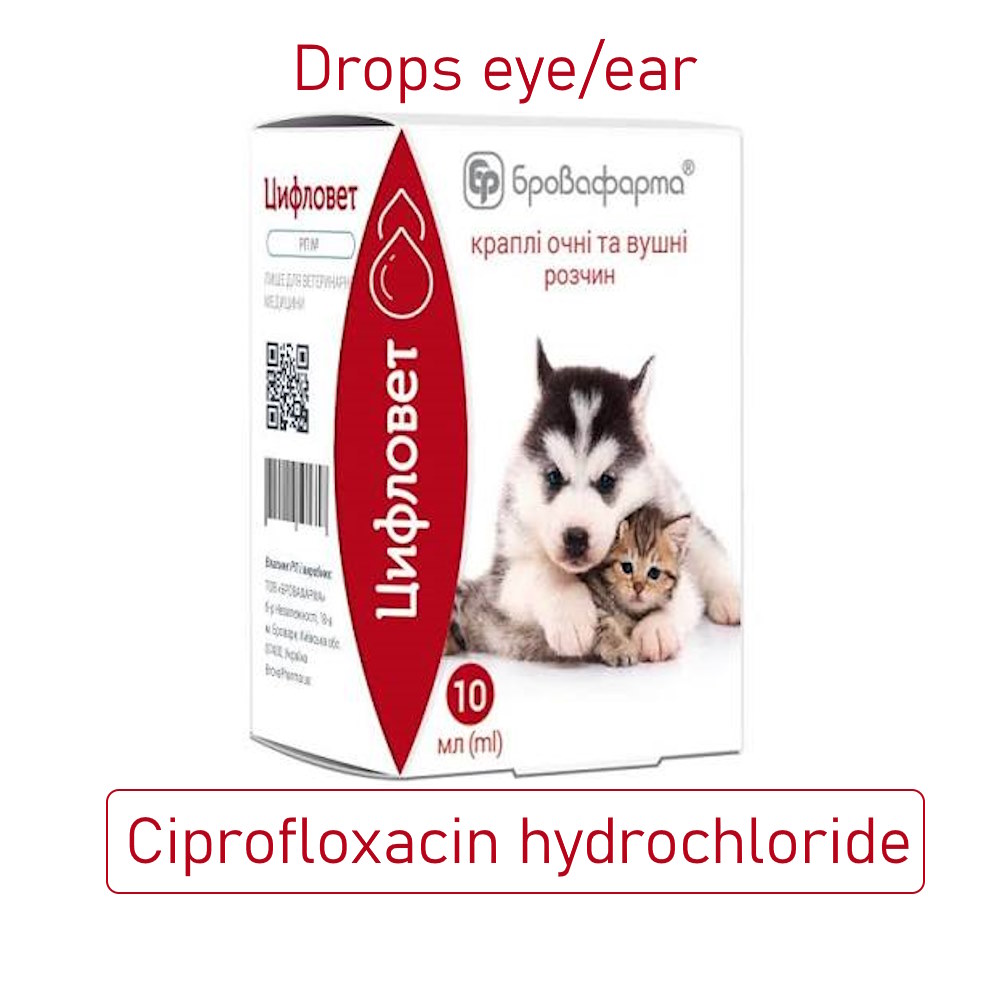


Ciprovet (ciprofloxacin) drops eye/ear suspension, 10 ml
Description
The solution is colorless or light yellow.
Composition
1 ml contains:
ciprofloxacin hydrochloride — 4.5 mg
Pharmacological properties
Ciprofloxacin is an antibiotic from the group of fluoroquinolones with a broad spectrum of bactericidal action. It inhibits DNA gyrase and suppresses bacterial DNA synthesis. It acts on gram-negative microorganisms during dormancy and division and causes cell wall lysis – Escherichia coli, Salmonella spp., Shigella spp., Proteus spp., Citrobacter spp., Klebsiella spp., Enterobacter spp., Vibrio spp., Campylobacter spp., Hafnia spp., Providencia stuartii, Haemophilus spp., Pasteurella multocida, Pseudomonas spp., Gardnerella spp., Neisseria spp., Moraxella catarrhalis Acinetobacter spp., Brucella spp., on gram-positive microorganisms during division – Staphylococcus spp., Streptococcus pyogenes, Streptococcus agalactiae, Corynebacterium diphtheriae, Listeria monocytogenes, on chlamydia Chlamydia spp. and mycoplasmas Mycoplasma spp., Mycobacterium spp.
When applied topically, it is rapidly absorbed. The concentration of ciprofloxacin in the blood plasma after instillation into the conjunctiva of 2 drops of a 0.3% solution every 2 hours for 2 days, and then every 4 hours for 5 days ranges from values that are not subject to quantitative assessment (<1 ng/ml) to 4.7 ng/ml. The half-life from the anterior chamber of the eye is 2 hours. When instilled into the eyes, the concentration in the blood does not exceed 2.5 ng/ml, when instilled into the ears, the maximum concentration in the blood is observed after 15-90 minutes.
It binds to plasma proteins by 16-43%, the half-life from plasma is 3-5 hours. Present in blood plasma mainly in a non-ionized form. Freely distributed in tissues and body fluids. Vd in the body is 2-3 l/kg. The concentration in tissues significantly exceeds the concentration in blood serum. Metabolized in the liver. Four metabolites of ciprofloxacin can be detected in the blood in small concentrations: diethylciprofloxacin (M1), sulfociprofloxacin (M2), oxociprofloxacin (M3), formylciprofloxacin (M4), three of which (M1-M3) exhibit antibacterial activity in vitro. It is similar to the antibacterial activity of nalidixic acid. The antibacterial activity in vitro of metabolite M4 (present in smaller quantities) is more similar to the activity of norfloxacin.
Ciprofloxacin is excreted from the body mainly by the kidneys by glomerular filtration and tubular secretion, a small amount – through the gastrointestinal tract. Within 24 hours, 15-50% of the dose is excreted in the urine unchanged, 10-15% in the form of metabolites. Approximately 20-40% is excreted in the feces unchanged and as metabolites within 5 days.
Indication
Treatment of dogs, cats, small exotic and ornamental animals for acute and chronic inflammation of the eyes and ears of infectious and traumatic origin – conjunctivitis, blepharitis, keratitis, keratoconjunctivitis, iriditis, iridocyclitis, corneal ulcers and erosions, eye diseases after injuries or foreign body ingestion, infectious otitis and otorrhea.
Contraindication
Do not use in animals with hypersensitivity to the active ingredient of the drug, with viral and fungal lesions of the eyes and ears, or during vaccination.
Use with caution in pregnant animals and animals under 7 days of age.
Method of administration and doses
The drug is instilled into the conjunctival sac 1-2 drops 2-4 times a day, in difficult cases – 1-2 drops every 2-3 hours, 1-2 days, into the ear canal – 1-4 drops (depending on the weight of the animal) 2-3 times a day.
If there is purulent or mucopurulent discharge, first perform hygienic treatment of the eyes and ears: first instill 3-4 drops and remove the discharge with a sterile gauze swab, after which 1-2 drops are instilled.
The course of treatment until complete recovery is 5-10 days.
Reservation
When used in recommended doses, side effects usually do not occur.
When instilled into the eyes, local irritation, itching, and tearing are sometimes possible, which pass quickly, rarely – allergic reactions, and with prolonged use – keratitis or deposits on the cornea.
Use with caution during pregnancy and lactation.
Do not use during vaccination.
Personnel working with the product must follow the hygiene and safety rules adopted when working with veterinary drugs.
If it gets on the skin, mucous membranes or in the eyes, it is necessary to rinse them with plenty of running water.
Storage conditions
In a dry, dark place, inaccessible to children, at a temperature of +10 to +25 °C.
After opening the bottle, use the drug within 30 days.
Expiration date
2 years.
Eye diseases in dogs and cats: effective treatment
Eye diseases in pets are a frequent reason for visits to a veterinary clinic. Most cases require urgent intervention by a specialist, as complications due to delay can lead to complete loss of vision in a dog or cat.
There are many types and forms of eye pathologies in pets. They can be primary, when the actual ophthalmological disease occurs, and secondary — the eyes suffer due to diseases of other organs and systems (for example, diabetes, hypertension, renal failure), injuries, and poisoning.
Pathologies can be congenital or develop under the influence of heredity, intoxication of various etiologies, injuries, metabolic disorders, age-related changes, vitamin deficiency, allergic reactions, autoimmune disorders.
Causes of eye inflammation in dogs and cats
Inflammation of the tissues of the visual organs is often caused by viral and bacterial infections, microbes, fungi, parasites. The most dangerous infections are in shelters and large kennels. Due to the crowding of animals, pathogens spread quickly, especially among young pets with unformed immunity.
In addition, animals often injure their eyesight during fights, games with children, and when foreign bodies get in. To notice pathology in time, it is necessary to carefully observe your pet and regularly examine its eyes.
Types of infections and diseases of the eye
7 common eye infections
- Feline Immunodeficiency Virus (FIV)
- Carnivorous plague
- Adenovirus infection in dogs
- Feline herpes
- Chlamydia
- Calcivirosis
- Feline infectious peritonitis (FIP) etc.
12 most common eye diseases
- Inversion or inversion of the eyelids, which often indicates an infection. Inversion, the cornea is constantly damaged by the eyelashes. Maine Coon, Shar Pei, and Bulldog breeds are prone to this.
- Dry eye syndrome is a chronic condition in which tear production is reduced. It occurs more often in dogs than in cats.
- Conjunctivitis is inflammation of the conjunctiva. It is often a symptom of an underlying disease.
- Cataract is a clouding of the lens of the eye. It is considered an age-related disease, but sometimes it is caused by a systemic pathology (for example, diabetes mellitus).
- Blepharitis is an inflammation of the eyelids. It can be both an independent disease and a symptom of other pathologies.
- Lens luxation is a pathological condition in which the lens is completely or partially displaced from its normal position in the eye or its stability is disrupted.
- Keratitis is a decrease in corneal transparency due to inflammation.
- Prolapse is the prolapse or inflammation of the third eyelid.
- Glaucoma is an increase in intraocular pressure with subsequent atrophy of the optic nerve.
- Uveitis is inflammation of the vascular network.
- Corneal erosions and ulcers are damage to the transparent front part of the eye.
- Eyeball prolapse (dislocation). Occurs after blows, falls, car accidents, more often in cats and dogs with bulging orbits.
Symptoms of eye diseases that cannot be ignored
- To prevent your pet from losing their vision, it is important not to miss ophthalmological pathology, and for this you need to know their main signs:
- purulent or serous discharge;
- squinting of one or both eyes;
- poor orientation in an unfamiliar place;
- tearing;
- photophobia;
- itching in the eyelid area (the pet constantly rubs its face with its paws);
- traces of tears on the fur;
- clouding, change in color of the iris;
- inability to open the eyelids;
- redness of the mucous membranes;
- The third eyelid is visible.
The listed symptoms are not specific, so most owners will not be able to diagnose them on their own. If any vision problems are detected in animals, you should urgently make an appointment with a veterinary clinic.
Treatment of eye diseases
Since most ophthalmic diseases are complicated by bacterial infection, eye drops will almost always be one of the components of complex therapy.
BROVAPHARMA offers Ciflyvet eye drops. They contain ciprofloxacin, a broad-spectrum antibiotic often used in ophthalmology.
Tsilovet is affordable and available in almost every veterinary pharmacy. With the correct dosage, reactions to it occur only in case of individual intolerance. The drops are safe even for young animals and are suitable for long-term use when an anti-inflammatory component is not needed.
In addition, the BROVAPHARMA portfolio includes Ciflodex drops, which, in addition to ciprofloxacin, contain a strong anti-inflammatory component – dexamethasone. The product helps get rid of pathogenic microorganisms and quickly eliminates signs of inflammation, but has some contraindications.
Eye drops for dogs and cats produced by BROVAPHARMA are a universal and profitable solution for pet owners. Tsiflovet is safe, has a wide spectrum of action and an affordable price. Tsiflodex helps in difficult cases when the infection is accompanied by inflammation.
For successful treatment of ophthalmological diseases in animals, contact a veterinarian at the first symptoms of eye damage. Only a doctor will quickly identify the cause of inflammation and, having various means in his arsenal, will select the optimal treatment regimen. This will help preserve your pet’s vision and prevent complications.