





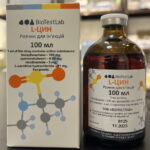
Amok suspension 100 ml
Original price was: 66.20 €.61.56 €Current price is: 61.56 €.
| Animals | , , , |
|---|---|
| Brands | |
| Form | , |


Amok (amoxicillin, clavulanic acid) suspension, 100 ml
Description
Suspension is white or light yellow, homogeneous, oily, sterile.
Composition
1 ml contains:
amoxicillin (as amoxicillin trihydrate) – 140 mg
clavulanic acid (in the form of potassium clavulanate) – 35 mg
Pharmacological properties
Amoxicillin is a broad-spectrum aminopenicillin antibiotic. It is effective against gram-positive microorganisms – Staphylococcus spp., Streptococcus spp., Arcanobacterium spp., Corynebacterium spp., Clostridium spp., Bacillus anthracis, Listeria monocytogenes, Erysipelothrix rhusiopathiae, and gram-negative microorganisms – Pasteurella spp., Haemophilus spp., Actinobacillus spp., Escherichia coli, Salmonella spp., Moraxella spp., Fusobacterium spp. The mechanism of action is to disrupt the synthesis of the bacterial cell wall by irreversibly blocking penicillin-binding proteins (PBPs) – the enzymes transpeptidase and carboxypeptidase.
Clavulanic acid has a ß-lactam structure similar to penicillins. Resistance to ß-lactam antibacterial drugs is due to the ability of microorganisms to produce ß-lactamase, an enzyme that destroys the ß-lactam rings of the antibiotic before it has time to affect the bacterial cell. Clavulanic acid inactivates ß-lactamase and restores the sensitivity of bacteria to the bactericidal action of amoxicillin in concentrations that are easily achieved in animal tissues after administration of the drug. It has a weak antibacterial effect; Klebsiella pneumoniae, Proteus spp., Bacteroides spp., Staphylococcus spp. are sensitive to it.
After subcutaneous and intramuscular administration to dogs and cats and after intramuscular administration to cattle and pigs, amoxicillin and clavulanic acid are rapidly absorbed and distributed throughout the body tissues, reaching high concentrations in muscle tissue, liver, and kidneys. Amoxicillin penetrates the brain and bone fluid in small amounts when there is no inflammation of the meninges. Amoxicillin can cross the placenta.
In cattle, the half-life of amoxicillin is 1.5 hours, and of clavulanic acid is 0.9–1.5 hours. After intramuscular administration of a therapeutic dose, the maximum serum concentration of amoxicillin is about 3 μg/ml, and of clavulanic acid is 2 μg/ml. After three injections, the concentration of both substances in the lungs can reach 30% of the serum concentration.
In dogs, after subcutaneous administration, the maximum serum concentration of amoxicillin is observed after 3 hours (6.0 μg/ml), of clavulanic acid – after 1 hour (4.8 μg/ml). The half-life of amoxicillin is 6.77 hours, of clavulanic acid – 0.78 hours.
In cats, after subcutaneous administration, the maximum concentration of amoxicillin in the blood serum is reached after 2 hours (16.5 μg/ml), clavulanic acid – after 0.5 hours (10.3 μg/ml). The half-life of amoxicillin is 1.09 hours, clavulanic acid – 0.61 hours.
Amoxicillin and clavulanic acid are excreted from the body mainly in the urine.
Indication
Treatment of animals for diseases caused by microorganisms sensitive to amoxicillin and clavulanic acid:
- cattle – metritis, mastitis, respiratory, skin and soft tissue diseases (including abscesses);
- pigs – colibacillosis, mastitis-metritis-agalactia syndrome, respiratory diseases;
- dogs, cats – diseases of the respiratory system, urinary tract, skin and soft tissues (including abscesses, pyoderma, anal sacculitis, gingivitis).
Contraindication
Do not administer to animals with hypersensitivity to penicillins and cephalosporins, as well as to animals with impaired renal function.
Do not use in horses (amoxicillin disrupts the microflora of the cecum), rabbits, guinea pigs, hamsters and other small herbivores.
Do not use simultaneously with antibiotics of the tetracycline, macrolide, sulfonamide and chloramphenicol groups.
Do not use intravenously or in case of known resistance to the active substances.
Method of administration and doses
Before use, the drug is shaken thoroughly and administered at a dose of 1 ml per 20 kg of body weight (7 mg of amoxicillin and 1.75 mg of clavulanic acid per 1 kg of body weight), once a day, the course is 3–5 days.
Dogs and cats are injected intramuscularly or subcutaneously, cattle and pigs – only intramuscularly, the injection site is lightly massaged. Only dry syringes and needles are used, since the activity of clavulanic acid decreases upon contact with water!
The minimum doses for dogs and cats are listed in the table.
| Animal species | Body weight, kg | Dose, ml | ||||
| Cats | 1 | 0.05 | ||||
| 3 | 0.15 | |||||
| 5 | 0.25 | |||||
| Dogs | 5 | 0.25 | ||||
| 10 | 0.5 | |||||
| 20 | 1 | |||||
| 30 | 1.,5 | |||||
| 40 | 2 | |||||
If the injection volume is greater than the values below, it is divided and injected into different sites: cattle – 15 ml, pigs – 10 ml, dogs – 2 ml, cats – 1 ml.
Reservation
Sometimes after the administration of the drug, pain or local tissue reactions occur. Rarely, allergic reactions to penicillins may occur, as well as gastrointestinal disorders (vomiting, diarrhea, anorexia). In the event of allergic reactions, the use of the drug is discontinued and antihistamines and corticosteroids are prescribed.
Before using the drug, a test for the sensitivity of pathogens to amoxicillin and clavulanic acid should be performed. If this is not possible, therapy should be based on the local epidemiological situation. Use of the drug outside the indications may cause the spread of strains resistant to its active substances and reduce the effectiveness of other penicillins due to possible cross-resistance.
Clavulanic acid is sensitive to moisture, so only dry syringes should be used. Even a small amount of water will cause dark brown specks, indicating contamination and reduced activity of the drug, so its use should be discontinued immediately.
No specific reactions were observed at the beginning of administration or after discontinuation of the drug. It is imperative to strictly observe the intervals between injections, since their extension reduces the effectiveness of the drug. If a dose is missed, it is administered as soon as possible and treatment is resumed according to the scheme.
The drug is prescribed to pregnant animals by a veterinarian only if the expected benefit to the mother outweighs the potential risk to the fetus. It can be used during lactation without restrictions.
After the last application of the drug, cattle can be slaughtered for meat after 42 days, pigs after 31 days. Milk can be consumed by humans after 60 hours. Meat and milk obtained before this period are disposed of or fed to unproductive animals, depending on the conclusion of a veterinarian.
Storage conditions
With caution (according to list B). In a dry, dark place, inaccessible to children, at a temperature of +3 to +25 °C.
After opening the bottle, store the drug in the refrigerator and use within 28 days.
Expiration date
2 years.