Online Pet Vet Pharmacy: Best Deals Up to 40% Off + FREE Shipping on Orders €100+




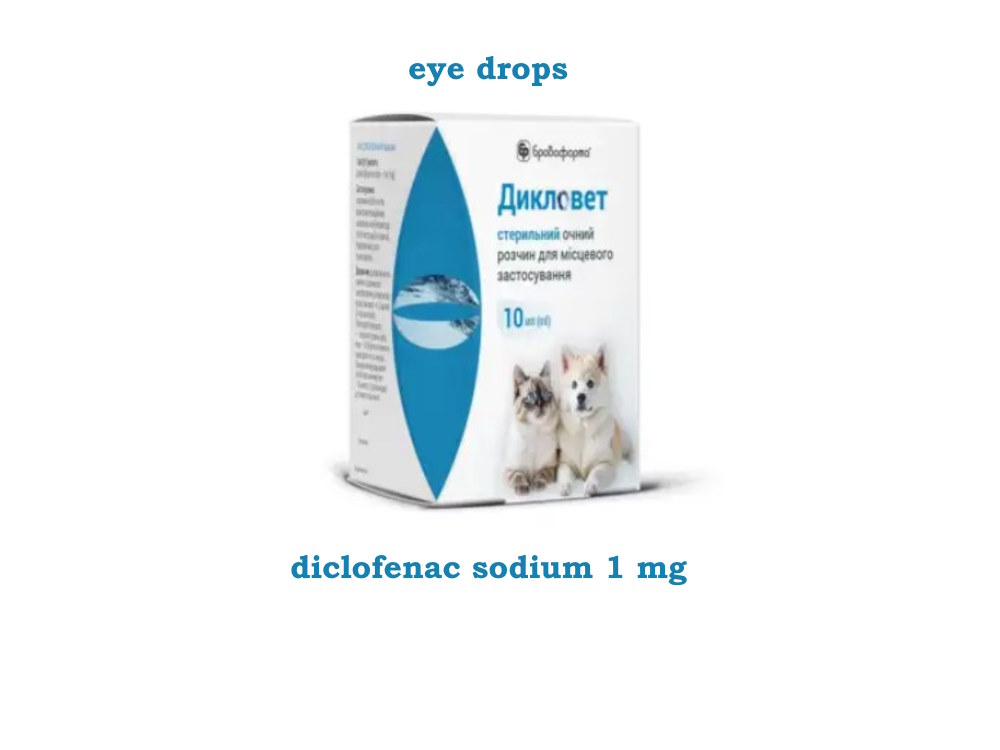


Diclovet eye drops 10 ml
Description
The solution is colorless, transparent.
Composition
1 ml of the drug contains:
diclofenac sodium — 1 mg
Pharmacological properties
Diclofenac sodium is a nonsteroidal anti-inflammatory drug. The mechanism of action is based on competitive inhibition of the enzymes cyclooxygenase-1 and cyclooxygenase-2 (COX-1 and COX-2), which blocks the conversion of arachidonic acid into precursors of prostaglandins (PGE 2 , PGI 2 ) and thromboxanes (TXA 2 ) – key mediators of inflammation, pain sensitivity and tissue edema. As a result, vascular permeability, leukocyte migration to the focus of inflammation and the formation of pain impulses are reduced.
After instillation of diclofenac sodium 0.1% (1 mg/ml) into the eye, the level of prostaglandins in the conjunctival fluid and anterior chamber of the eye decreases rapidly. Therapeutic concentrations in the conjunctiva and cornea are reached after approximately 30 minutes. The maximum concentration of the drug in the anterior chamber of the eye (80–130 ng/ml) is observed after 2–3 hours, which provides a pronounced inhibition of prostaglandin PGE₂ synthesis and sufficient inhibition of COX-2. The anti-inflammatory effect persists for at least 4 hours, which determines the frequency of use of the drug 2–4 times a day.
When diclofenac sodium is instilled, its systemic absorption is minimal: in healthy animals, clinically significant plasma concentrations are not detected during the first 4–6 hours. Diclofenac sodium accumulates in the cornea and conjunctiva within 30 minutes after instillation. The maximum concentration in the anterior chamber of the eye is reached after 2–3 hours, after which the level gradually decreases, remaining within <20 ng/ml for 6–8 hours. In the chorioretinal tissue, the maximum concentration (Cₘₐₓ ≈ 38 ng/g) is reached 1 hour after a single application, the half-life (T₁/₂) is approximately 1.9 hours.
With systemic absorption of a small amount of the drug, it quickly binds to blood plasma albumin (99%) and undergoes intensive metabolism in the liver (glucuronide and sulfate conjugates).
The half-life of diclofenac from blood plasma after intravenous administration is 1–2 hours. When used in ophthalmology, almost all of the drug is washed away by tear fluid within 6–8 hours due to low systemic absorption. Metabolites are excreted mainly by the kidneys (up to 60%), partially with bile.
Indication
Treatment of dogs and cats after cataract extraction, intraocular lens implantation, and other operations on the anterior segment of the eye (on the iris, cornea, in the anterior chamber of the eye) accompanied by inflammatory processes.
Treatment of non-infectious inflammatory eye diseases with pain syndrome.
Prevention and reduction of postoperative iritis during cataract surgery, as well as prevention of intraoperative and postoperative miosis.
Contraindication
Do not use in animals with hypersensitivity to diclofenac and other NSAIDs, with corneal ulcers or wounds, as this may delay healing.
Do not use in case of hemophthalmia and systemic blood clotting disorders.
Method of administration and doses
The dose is determined depending on the severity of the disease, on average it is 1–2 drops, 2–4 times a day.
After cataract surgery – 1 drop, 4 times a day, course – 14–30 days, starting a day after surgery.
For chronic iridocyclitis and/or isolated iritis – 1 drop, 1–2 times a day until complete recovery.
Reservation
The most common side effects are mild eye irritation, sometimes increased photosensitivity. In case of allergic reactions or hemorrhages in the eye, treatment should be discontinued and a veterinarian should be consulted.
Do not instill simultaneously with other eye drops. If necessary, use other drops, they should be instilled at least 15 minutes apart. Use with caution in cases of bleeding tendency, stomach ulcer, asthma (preservatives can provoke an attack of bronchospasm).
Use during pregnancy and lactation is possible only under the supervision of a veterinarian and after assessing the risk/benefit for the animal’s health.
Concomitant use with antithrombotic drugs (aspirin, heparin) increases the risk of bleeding. Do not use with other NSAIDs or corticosteroids without consulting a veterinarian.
In case of ingestion, gastrointestinal and nervous system reactions are possible. Symptomatic treatment is recommended: gastric lavage, supportive therapy.
The drug is not used for productive animals.
Storage conditions
In a dark place, out of reach of children, at a temperature of +15 to +25 °C.
After opening the bottle, store the drug in the refrigerator and use within 28 days.
Do not freeze!
Expiration date
2 years.
DICLOVET FOR DOGS AND CATS: WHEN ARE ANTI-INFLAMMATORY EYE DROPS USED?
Eye redness, tearing, squinting, photophobia, or pain can be signs of eye inflammation in dogs and cats. These symptoms can occur after trauma, surgery, or diseases of the cornea and internal structures of the eye.
It is important to understand that the same external manifestations can be observed in different diseases. Therefore, before using eye medications, it is necessary to establish the cause of the inflammation.
In veterinary ophthalmology, topical nonsteroidal anti-inflammatory drugs (NSAIDs) are used to control pain and inflammation in certain clinical situations. This group includes diclofenac sodium, which is a component of Diclovet eye drops .
Why does eye inflammation occur after surgery or injury?
After ophthalmic surgery, trauma, or non-infectious inflammation, biologically active substances, including prostaglandins, are formed in the tissues of the eye. They participate in the development of the inflammatory reaction and contribute to the appearance of characteristic symptoms – redness, pain and discomfort, swelling, increased sensitivity to light, eyelid spasm, and changes in the pupil reaction.
Inflammation is part of the body’s natural defense response. However, an excessive inflammatory response can cause pain and disrupt the normal functioning of the eye.
The veterinarian’s task is to control inflammation without hindering tissue repair or hiding signs of possible complications.
How do anti-inflammatory eye drops work?
Nonsteroidal anti-inflammatory eye drops inhibit the activity of cyclooxygenase, an enzyme involved in the formation of prostaglandins. Reducing the synthesis of these substances helps reduce the inflammatory response and associated pain.
In veterinary ophthalmology, topical NSAIDs can be used to control postoperative inflammation, pain, photophobia, and some forms of noninfectious inflammation of the anterior segment of the eye.
Unlike corticosteroids, particularly dexamethasone, NSAIDs do not have the same pronounced immunosuppressive effect. However, this does not mean that they are safe for all eye diseases.
Special caution is required when using topical NSAIDs for corneal injuries, as they may slow down the healing of the corneal epithelium.
What is Diclovet and how does it work?
Diclovet is a veterinary ophthalmic drug in the form of eye drops for topical use. Its active ingredient is diclofenac sodium, a nonsteroidal anti-inflammatory drug.
Diclofenac inhibits the formation of prostaglandins, thereby helping to reduce inflammation and pain in the tissues of the eye.
After instillation, the drug acts mainly locally. At the same time, a certain amount of the active substance may enter the systemic circulation, so when prescribing it, it is necessary to take into account the general condition of the animal and concomitant treatment.
When is Diclovet used?
Diclovet eye drops may be prescribed by a veterinarian to control non-infectious inflammation and pain in certain ophthalmological situations.
| Clinical situation | Purpose of application |
|---|---|
| After cataract surgery or intraocular lens implantation | Control of postoperative inflammation and pain |
| After surgical interventions on the anterior segment of the eye | Reducing the inflammatory response |
| Prevention of surgical miosis | Reduction of pupil constriction associated with prostaglandin formation |
| Certain non-infectious inflammatory diseases of the anterior segment of the eye | Control of inflammation and pain as part of complex therapy |
Diclovet should be used according to the indications specified in the approved instructions for the drug.
Important! Diclovet is not intended for self-treatment of eye redness. Before use, the doctor must exclude conditions in which topical NSAIDs may worsen the course of the disease.
Why can’t Diclovet be used for corneal ulcers?
A corneal ulcer in dogs and cats is damage to its superficial or deeper layers.
With such lesions, it is especially important not to interfere with the natural regeneration of tissues.
Topical NSAIDs may slow corneal healing and increase the risk of complications, so they should not be used for ulcerative lesions.
Before prescribing the drug, the veterinarian may conduct a special study with fluorescein, which helps detect defects in the corneal epithelium.
If the animal squints its eye severely, avoids light, or has severe redness or clouding of the cornea, it is necessary to contact a veterinarian as soon as possible.
How to correctly use Diklovet with other eye medications?
In the complex treatment of eye inflammation in dogs and cats, the doctor may prescribe several ophthalmic drugs.
To ensure proper use of medications, follow these recommendations:
1. Maintain intervals between instillations. If multiple eye drops are prescribed, apply them sequentially at the intervals recommended by your veterinarian.
2. Apply eye gels and ointments last. This ensures better contact of aqueous solutions with the surface of the eye.
3. Do not touch the tip of the bottle to your eye, eyelids, fur or hands. This reduces the risk of contamination of the product.
4. Do not change the dosage and duration of treatment yourself. Even if redness or pain has decreased, follow the prescribed regimen.
5. Inform your veterinarian about other medications your pet is taking, especially if you are taking systemic NSAIDs, corticosteroids, or blood thinners.
If after instillation the pain increases, severe photophobia appears or the eye condition worsens, it is necessary to stop using the drug until consulting a veterinarian.
Diclovet: control of inflammation under the supervision of a veterinarian
Topical nonsteroidal anti-inflammatory drugs play an important role in veterinary ophthalmology, especially after surgical interventions and in certain non-infectious inflammatory diseases.
Diklovet can be part of a comprehensive therapy provided that the diagnosis is correctly established, contraindications are excluded, and the prescribed treatment regimen is followed.